Stellar Evolution
A map of how stars live and die
An accessible guide to stellar lifecycles - from the hydrogen-burning main sequence to red giants, white dwarfs, and beyond. Using the Hertzsprung-Russell diagram as our map, we'll explore how every star in the night sky is on a journey through the same cosmic story.
Stellar Evolution
A map of how stars live and die
Stars Don't Last Forever
The Sun rises every morning. It's been doing that for as long as humans have existed, and for billions of years before that. It feels permanent - the most reliable thing in the sky.
But the Sun is a fire, and fires run out of fuel.
In about 5 billion years, the Sun will swell into a red giant, expanding past Mercury, past Venus, possibly engulfing Earth. Its outer layers will drift away as a glowing nebula. What's left will be a white dwarf - a dense ember the size of Earth, slowly cooling for eternity.
Every star you see in the night sky is somewhere on this same journey. Some are young, burning hot and blue. Some are middle-aged like our Sun. Some are dying, swollen and red. Some are already dead - white dwarfs, neutron stars, black holes.
There's a map that shows all of this at once.
The Map
A century ago, astronomers discovered something remarkable. If you plot stars by their colour (which tells you temperature) against their brightness, they don't scatter randomly. They cluster in patterns.
Most stars fall on a diagonal band called the main sequence - that's where stars spend most of their lives, steadily burning hydrogen. Our Sun is there right now.
But look at the corners. Top right: red giants - cool but enormously bright because they're huge. Bottom left: white dwarfs - hot but dim because they're tiny.
This diagram isn't just a snapshot. It's a map of stellar lives. Where a star sits tells you what it's doing now. Where it will move tells you its future.
Regions
How to read it
Left to right: Temperature (hot blue stars on left, cool red stars on right)
Bottom to top: Brightness (dim stars at bottom, luminous stars at top)
The Hertzsprung-Russell diagram plots stars by temperature and brightness. Hover over regions to learn what different positions mean.
Three Million Stars
That's the theory. Here's the reality.
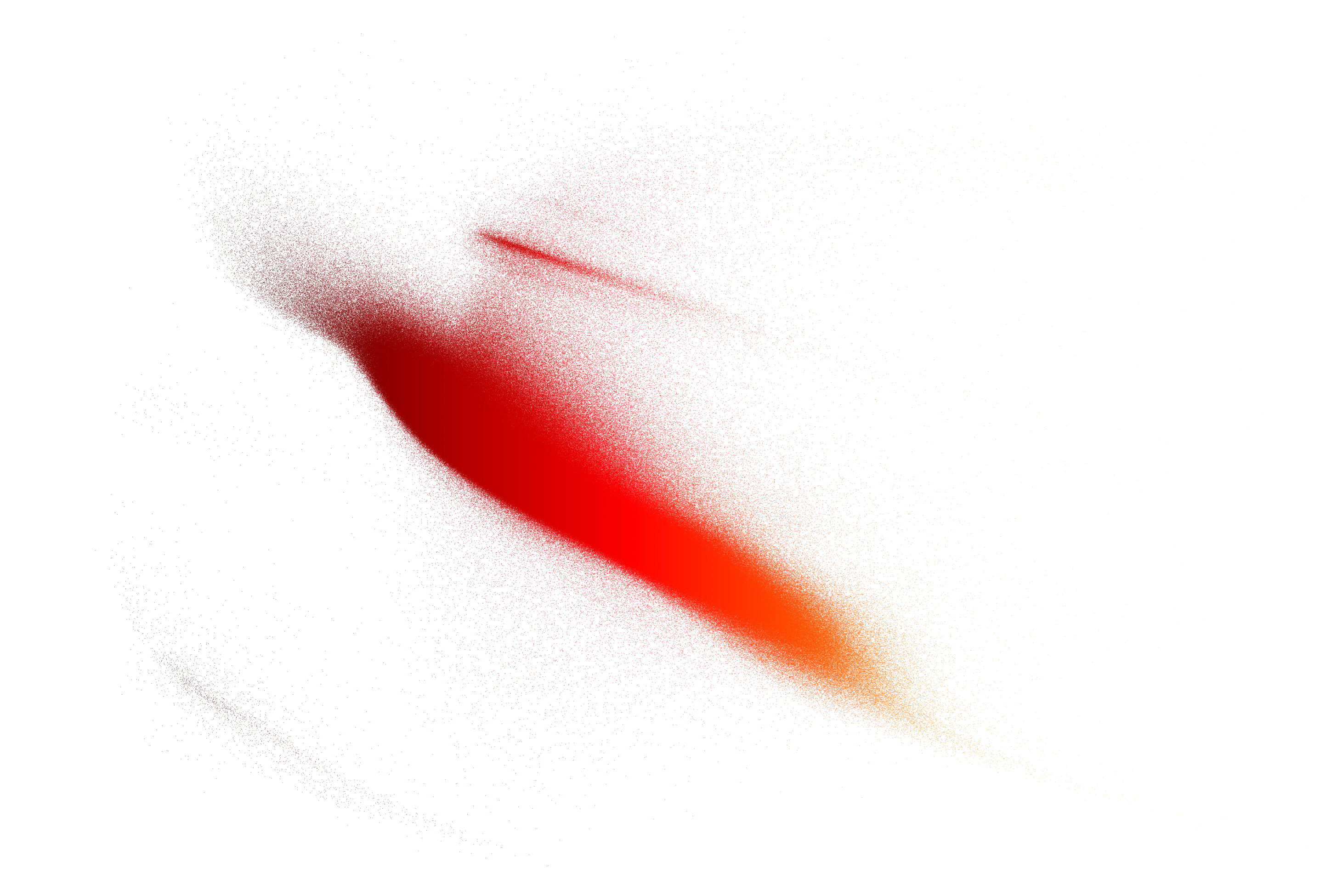
This diagram shows three million real stars, measured by the GAIA space telescope with unprecedented precision. Every dot is an actual star in our galaxy.
Notice how they cluster. The main sequence isn't a neat line - it's a dense river of stars, because that's where stars spend most of their lives. The giants and white dwarfs are sparser by comparison - those phases are brief.
This is what the night sky looks like when you can see it all at once.
Stars You Know
Let's find some familiar faces on this map.
The Sun sits in the middle of the main sequence - a thoroughly average star. Sirius, the brightest star in our night sky, is hotter and brighter, sitting higher on the main sequence.
Betelgeuse - the red shoulder of Orion - is a red supergiant in the top right. It's so large that if you put it where the Sun is, it would swallow Jupiter. It's near the end of its life and could explode as a supernova any time in the next hundred thousand years.
And Sirius B, the white dwarf companion to Sirius, sits in the bottom left - the cooling remnant of a star that died long ago.
Categories
Click any star to see its details. Try finding the Sun, Betelgeuse, or Sirius.
Famous stars plotted on the HR diagram. Click any star for details. Toggle categories to isolate different stellar types.
The Sun's Future
Stars don't stay in one place on this diagram. They move - slowly, over billions of years.
The Sun has been on the main sequence for about 4.6 billion years. It will stay there for another 5 billion, steadily burning hydrogen in its core.
Then things get dramatic.
As the hydrogen runs out, the core contracts and heats up. The outer layers expand and cool. The Sun swells into a red giant, moving from the main sequence toward the top right of the diagram.
At its largest, the Sun will be about 200 times its current size.
Eventually, the outer layers drift away, leaving only the core - a white dwarf. The Sun slides down to the bottom left of the diagram, where it will slowly cool and fade over trillions of years.
Present Sun
Age: 4.6 GyrToday. The Sun is about halfway through its main sequence lifetime.
The Sun's evolutionary path through the HR diagram. Press play to watch 12+ billion years unfold, or drag the slider to explore different phases.
Mass Is Destiny
Not all stars end as white dwarfs. A star's mass at birth determines everything about its life - how long it lives, how brightly it burns, and how it dies.
Small stars (less than half the Sun's mass) burn slowly and live for hundreds of billions of years - longer than the current age of the universe. They'll eventually become white dwarfs.
Sun-like stars live about 10 billion years. Red giant, planetary nebula, white dwarf.
Massive stars (8+ times the Sun's mass) live fast and die young - just millions of years. They swell into supergiants, then explode as supernovae. What's left is a neutron star (an unimaginably dense ball of neutrons) or, for the most massive stars, a black hole.
The heavier you start, the more dramatic your ending.
Stellar Mass
Sun-like Star
Mass: 1 M☉End States
More massive stars burn brighter but die younger. The most massive stars live only millions of years before exploding as supernovae.
Different stellar masses follow different evolutionary paths. Toggle paths to compare how mass determines destiny.
Reading the Night Sky
Look at the HR diagram now, and you see something different than you did ten minutes ago.
You see a population - billions of stars, each on its own journey. The main sequence isn't just a cluster; it's where stars spend most of their lives. The outliers aren't random; they're stars at the beginning or end of their stories.
You can find a star like Betelgeuse and know it's near death. You can find a white dwarf and know it's a stellar corpse. You can find a blue giant and know it's burning through its fuel at a furious rate.
The night sky isn't static. It's a snapshot of stellar lives in progress. Now you can read it.
Going Deeper
For the curious - you've got the main idea, this is extra.
Spectral Classification
Astronomers classify stars by spectral type: O, B, A, F, G, K, M - from hottest to coolest. The Sun is a G-type star. The letters come from historical classification systems, which is why they're not in alphabetical order.
A popular mnemonic: "Oh Be A Fine Girl/Guy, Kiss Me."
The spectral type appears along the top of the HR diagram, mapping temperature to colour. O stars are blue-white and scorching hot. M stars are red and relatively cool.
The Gaia Mission
The data behind these visualisations comes from the European Space Agency's Gaia spacecraft, which has measured the positions, distances, and brightnesses of nearly two billion stars with unprecedented precision.
Before Gaia, accurate distances were only known for a few thousand nearby stars. Now we have reliable data for millions. This transforms the HR diagram from a schematic illustration into a genuine census of the stellar neighbourhood.
We Are Star Stuff
Stars don't just burn - they build. In their cores, they forge heavier elements from lighter ones. The Sun is currently fusing hydrogen into helium. Larger stars fuse helium into carbon, carbon into oxygen, all the way up to iron.
Everything heavier than iron - gold, uranium, the iodine in your thyroid - is created in the violence of supernovae and neutron star collisions.
The calcium in your bones, the iron in your blood, the oxygen you're breathing - all of it was forged inside stars that died before the Sun was born. We are, quite literally, made of star stuff.
Further Exploration
Recommended Reading
- The Life and Death of Stars - Kenneth R. LangComprehensive but accessible
Watch
- Kurzgesagt: The Life and Death of StarsBeautifully animated overview